If you look at the modern web, 90% of it is engineered to do exactly one thing: push you down a sales funnel. The internet has been paved over by B2B (Business-to-Business) SaaS companies building sterile, hyper-optimized landing pages. Every site has the same corporate Memphis art, the same generic “synergy” copy, and the same desperate, glowing Call-to-Action button begging for your email address.
It is the architecture of the Slop Economy. And it is incredibly boring.
At Vibeaxis, we spend a lot of time parodying this soulless corporate culture. But recently, we realized that to truly mock the system, you have to use the system against itself. To build hyper-fast, accessible browser games, we didn’t need to write a massive proprietary game engine from scratch. We just needed to perform a digital heist.
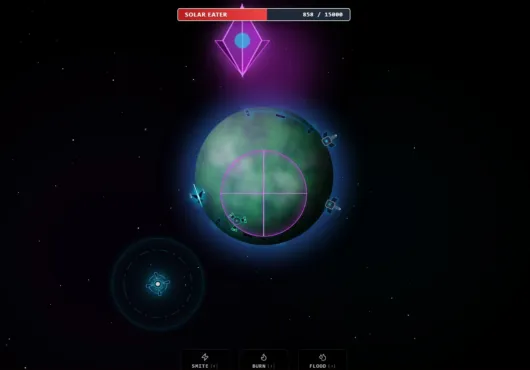
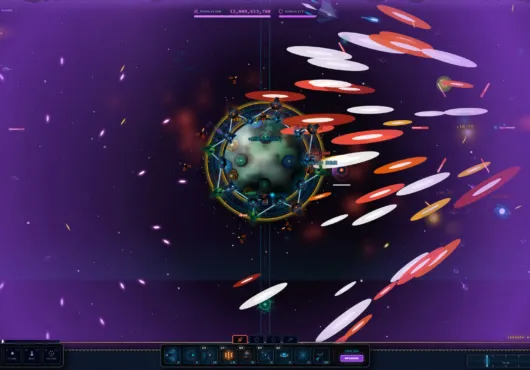
We took an enterprise-grade B2B landing page builder, gutted its corporate internals, and used its highly-optimized chassis to deploy Divine Orbit, a 144Hz real-time strategy space game.
Here is exactly how you turn a lead-gen funnel into a galactic warzone, and why the future of indie game development lies in scavenging corporate ruins.
The Economics of the Trojan Horse
To understand why we hijacked a web builder, you have to understand the economics of the modern web. Companies like AWS, Vercel, and Hostinger spend billions of dollars and countless engineering hours optimizing one metric: TTFB (Time to First Byte).
In the corporate world, if a landing page takes more than 1.5 seconds to load, the lead bounces, and the company loses money. Therefore, the web-builders these companies provide (like Hostinger’s Horizons platform) export incredibly lean, perfectly bundled React/HTML architectures. The routing, the CSS minification, the Webpack bundling, and the responsive grid layouts are mathematically perfected.
As indie game developers, we looked at that and realized something crucial: Corporate developers already solved the web optimization problem for us. Instead of exporting a heavy 50MB WebGL Unity build that forces players to stare at a loading bar for two minutes (a trap we actively avoid), we took the enterprise SaaS export. We stole their multi-million dollar TTFB optimization and used it to render a fleet of spaceships instantly.
The Frame-Rate Problem: Delta-Time in a Corporate Wrapper
When you rip the rendering engine out of a game and replace it with a raw HTML5 canvas, you run into an immediate, catastrophic issue: Monitor refresh rates.
If you tie your game’s movement speed to the requestAnimationFrame loop, your physics are bound to the hardware. A player on a standard 60Hz corporate laptop will see the game run at normal speed. A player on a 144Hz gaming monitor will see the game run at fast-forward, completely breaking the difficulty curve. Standard game engines like Unity or Godot handle this calculation for you in the background. When you build a custom engine inside a SaaS wrapper, you are on your own.
To fix this, we had to write a custom Delta-Time (dt) calculator directly into the JavaScript loop.
Instead of saying “move this ship 5 pixels every frame,” the engine calculates exactly how many milliseconds have passed since the last frame was drawn. We then multiply the ship’s velocity by that time difference. It is a fundamental piece of game engineering, but injecting it into a React environment requires extreme care. If your Delta-Time calculation triggers a React state update, you instantly fall back into the React Death Loop.
By keeping the Delta-Time math strictly inside isolated, mutable useRef hooks, we forced a B2B landing page to calculate sub-millisecond physics perfectly across any hardware configuration, from a 2015 Macbook to a modern gaming rig.
Gutting the Funnel: The UI Illusion
To make this work, you have to strip out the corporate organs while keeping the skeleton intact.
When you export a site from a B2B builder, it gives you a series of React components meant for pricing tiers, testimonial sliders, and contact forms. We kept this entire UI layer, but we recontextualized it. A B2B web builder is actually the perfect tool for designing a high-tech game HUD, because corporate dashboards already look like spaceship control panels.
- The Pricing Matrix becomes the Quartermaster’s ship upgrade screen.
- The Analytics Dashboard becomes the active fleet telemetry overlay.
- The Lead-Gen Form becomes the exact terminal interface we used in EJECT! Terminal Drop Simulator.
Sidebar: The Dystopian Venn Diagram
Why does corporate enterprise software map so perfectly onto survival-horror sci-fi? Because their underlying philosophies are identical. Both are designed to maximize human output, eliminate friction, and prioritize metrics over joy. A B2B sales dashboard and the telemetry screen of a failing drop pod are both just brutally efficient data delivery systems trying to keep a system from crashing. By stripping out the corporate branding and leaving the raw data grids, we didn’t have to design a cyberpunk aesthetic—we just exposed the one that was already there.
By reusing the native CSS grids generated by the enterprise builder, we achieved a perfect, responsive, brutalist sci-fi aesthetic with zero extra CSS engineering. It proves a point we made in Synergynet: The B2B Hustle Simulator: corporate metrics and dystopian sci-fi are visually indistinguishable.
Anatomy of a Hijacked UI: Re-mapping the Slop
We mentioned earlier that corporate dashboards look like spaceship control panels, but the actual re-mapping process is where the true indie-hacker magic happens.
We didn’t just use the overarching CSS grid; we took specific, highly-optimized React components meant for digital marketing and twisted them to serve game mechanics.
- The Cookie Consent Banner: In standard web dev, this is an annoying popup that ruins the UX. In Divine Orbit, we hijacked the fixed-position bottom-toast component and turned it into the Incoming Transmission Alert. Instead of asking to track your data, it warns you of incoming enemy fleets.
- The “Meet the Team” Grid: SaaS templates always include a masonry grid of smiling employees. We stripped the
.jpgassets, kept the CSS flexbox logic, and turned it into the Unit Selection Roster. - The Monthly/Yearly Pricing Toggle: That little sliding switch designed to trick you into an annual subscription? We wired it into the combat system. It is now the Weapon Fire-Mode Toggle, switching your ship’s armaments from kinetic to thermal.
- The Progress Bar: Originally designed to show how “complete” a user’s profile is to encourage onboarding, this component was perfectly coded to update width dynamically. We fed it the player’s hull integrity data, turning a corporate metric into a real-time health bar.
By scavenging these pre-built components, we saved weeks of UI programming. We let the enterprise developers write the accessible, responsive CSS, and we just changed the variables.
Bypassing the DOM: The Canvas Injection
Having a fast-loading UI is great, but it doesn’t make a game. The reason most browser games fail is that developers try to animate standard DOM elements (like moving a <div> across the screen). The browser’s layout engine panics, repaints the whole screen, triggers a React virtual DOM diff, and your frame rate tanks to 12 FPS.
To achieve 144Hz performance, we had to isolate the game logic from the corporate chassis. Where the “Subscribe to our Newsletter” form was supposed to go, we injected a raw HTML5 <canvas> element that takes up the entire screen.
Technical Warning: The React Death Loop
If you are a junior developer attempting to build a browser game, you will inevitably fall into the React Death Loop. You will put your player’s X and Y coordinates into a
useStatehook.Here is what happens next: The player moves. State updates. React triggers a Virtual DOM reconciliation. The browser recalculates the CSS layout. The DOM paints. If you do this at 144 frames per second, you are asking the browser to rebuild the entire website 144 times a second. Your CPU will fan up like a jet engine, and your game will stutter to a halt. This is why you must decouple the React state machine from the
requestAnimationFrameloop. Store mutable physics data inuseRefobjects—they persist data without ever triggering a DOM re-render.
We wired a custom JavaScript requestAnimationFrame loop directly into the canvas. The React chassis handles all the slow, state-based menu routing (saving games, buying upgrades, pausing). Meanwhile, our custom injected engine reads from mutable useRef hooks to calculate physics and draw thousands of active projectiles and entities to the screen, completely ignoring React’s component lifecycle.
The corporate wrapper handles the persistence; the injected canvas handles the violence.
The Zero-Asset Rebellion (Math Over Megabytes)
The final piece of the heist was eliminating the CDN (Content Delivery Network) bloat. B2B websites are notorious for loading massive, unoptimized WebP images of smiling professionals pointing at graphs. Game engines are just as bad, forcing you to download megabytes of sprite sheets and .wav audio files.
We enforce a strict zero-asset policy to keep the payload under a few megabytes.
- Visuals: We use raw CSS mathematical animations for terminal scanlines and native Canvas API drawing functions for the ships.
- Audio: Instead of loading external MP3s, we wire directly into the native Web Audio API. Every laser blast, thruster burn, and proximity alarm is synthesized in real-time from raw mathematical oscillators directly on the user’s CPU.
The Payload Reality Check
To understand why “Math Over Megabytes” matters, look at the payload numbers of modern web experiences:
- Standard B2B Landing Page: 2.5 MB to 5 MB (mostly unoptimized hero images and tracking scripts).
- Standard Unity WebGL Export: 15 MB to 30 MB (just for the engine runtime and basic assets).
- Vibeaxis / EJECT!: < 500 KB.
We aren’t just saving bandwidth; we are saving attention spans. In the modern attention economy, a 5-second loading bar is a death sentence. By keeping the payload microscopic, the time-to-interactivity is near zero. Before the player even realizes they clicked a link, the hull is already burning.
This forces a cohesive, gritty, retro aesthetic that you simply cannot get by piecing together store-bought assets (a trap known as the Fiverr Frankenstein).
The Electron Escape Pod
The beauty of this Trojan Horse method is its absolute versatility. Because the entire application is just an ultra-lightweight HTML/JS payload, we aren’t restricted to the browser.
By taking that exact corporate-exported code and wrapping it in an Electron shell, we instantly converted a “web page” into a standalone, executable desktop game. No Unity compiling, no C++ dependency hell. Just pure web technology running natively on Windows, Mac, and Linux.
The Ultimate Exploit: Infinite Edge Hosting
The final advantage of this Trojan Horse architecture isn’t just about performance—it’s about server economics.
When you build a multiplayer game or a massive WebGL project, hosting is a nightmare. You either have to pay for dedicated servers, rely on platform monopolies like Steam or Itch.io, or watch your AWS bill explode when your game gets a traffic spike on Reddit.
Because our B2B-hijack method results in a final payload of less than 500 kilobytes of static HTML, CSS, and vanilla JS, we circumvent traditional game hosting entirely. We can deploy our games to Edge Networks like Cloudflare Pages or Vercel for exactly zero dollars.
These networks are designed to cache static corporate sites on servers all over the globe, ensuring that a user in Tokyo and a user in London both get sub-second load times. By dressing our game up as a static SaaS site, we get to piggyback on this trillion-dollar infrastructure for free.
If Divine Orbit goes viral and 100,000 people try to play it at the exact same moment, the servers won’t crash. We won’t get a massive bandwidth bill. The edge network will just serve the 500kb payload from the node closest to the user, flawlessly, without a drop in frame rate.
We aren’t just hijacking their frontend UI. We are hijacking their global server infrastructure.
Play in the Corporate Ruins
There is a massive psychological thrill in taking a framework meant for corporate drudgery and forcing it to run an arcade game. We are surrounded by trillion-dollar infrastructures designed to serve us ads and harvest our data. As indie developers, we have a unique opportunity—and perhaps a responsibility—to hijack those infrastructures and turn them into toys.
The developers who survive the next era of the web won’t be the ones playing by the rules of the platform monopolies or grinding out AI-generated slop. They will be the ones who know how to creatively scavenge and misuse the tools right in front of them.
You can see the results of this B2B-hijack architecture live right now. Command the fleet in Divine Orbit, or experience the pure math-driven anxiety of EJECT!.
Stop building funnels. Start building drop pods.