The internet used to be a place you went. Now, it’s a place you endure.
If you’ve spent more than ten minutes online recently, you already know the feeling. The friction. The subtle, creeping realization that the content you are looking at wasn’t made for you—it was made for a machine. We are living in the era of the Slop Economy, a digital ecosystem where human connection has been replaced by engagement bait, synthetic media, and algorithmic slot machines designed to strip-mine your attention.
The Dead Internet Theory isn’t a conspiracy anymore; it’s a business model.
But you still have to live, work, and exist here. So how do you survive a web that is actively hostile to your brain? You stop acting like a consumer, and you start acting like a sysadmin of your own attention.
Here is the Vibeaxis guide to surviving the digital wasteland.
Part 1: The Engagement Casino and the Death of Intent
The modern feed does not care what you want to see. It cares what you cannot look away from.
Remember when you could type a question into a search engine and get an actual answer? Now, you get a 2,000-word SEO-optimized essay generated by an AI, fact-checked by nobody, and padded with unskippable video ads. The internet has fundamentally shifted from a library of intent to a casino of distraction. You don’t find things anymore; things are fed to you. The platforms realized early on that answering your questions quickly is bad for business. If you find what you need and leave, they can’t serve you ads. So, they killed intent. They replaced chronological timelines with algorithmic feeds designed to trap you in a frictionless maze of outrage and absurdity.
Algorithms have figured out that human beings are neurologically hardwired to respond to outrage, absurdity, and “slop”—low-effort, high-volume content designed to game retention metrics. The platforms have gamified your psychology, turning every scroll into a pull of a slot machine lever.
The Vibeaxis Reality Check: You aren’t the customer. You aren’t even the product. You are the battery powering an engagement farm.
If you want to understand exactly how insidious this loop is without destroying your own dopamine receptors, you need to see it from the other side of the screen. We built Ratio Royale so you can step into the shoes of a dystopian social media manager. It’s an engagement farming clicker that forces you to manipulate the algorithm for total digital dominance. Once you play it, you will never look at a viral thread the same way again.
Part 2: Calculating (and Evading) the Doomscroll Tax
The platforms didn’t design your feed to entertain you; they designed it to hack your dopamine receptors. The infinite scroll is modeled directly on casino slot machines—relying on a psychological concept called a “variable ratio schedule.” You swipe, you feel nothing. You swipe, you get angry at a political take. You swipe, you see a funny video. That exact unpredictability is what paralyzes your prefrontal cortex and keeps your thumb moving. It is the reason you can sit on your couch, stare at a glowing rectangle for three hours, and go to bed feeling completely hollow, exhausted, and angry at people you don’t even know.
In the Slop Economy, your attention is currency, and the platforms are taxing you heavily.
We call this the Doomscroll Tax: the invisible hours you lose staring at synthetic drama, AI-generated life hacks, and frictionless feed garbage. It feels like “relaxing,” but it’s actually a low-grade cognitive drain. You close the app feeling more exhausted than when you opened it.
To survive the dead web, you have to audit your attention.
- Calculate the Damage: Stop guessing how much time the algorithm is stealing from you. Run your numbers through the Doomscroll Tax Calculator to see the actual, quantifiable cost of your daily screen time.
- Deploy Countermeasures: Once you see the math, you need a firewall for your brain. This is where tools like Adblock for Feelings come in. You don’t just need to block pop-ups anymore; you need to block emotional manipulation.
Part 3: Identifying the Synthetic Rot
The “Dead Internet Theory” used to be a fringe Reddit conspiracy. Today, it’s just standard operating procedure. We are currently drowning in a digital uncanny valley where bots generate content to be scraped by other bots, just to serve ads to more bots. Real human voices are being drowned out by server farms pumping out synthetic drama, hallucinated news articles, and automated outrage. Because AI generation costs practically zero dollars, the sheer volume of this “slop” is breaking the basic mechanics of online discovery. When human intent is replaced by automated output, the internet rots from the inside out.
The Dead Web isn’t just populated by angry algorithms; it’s drowning in synthetic filler. We call this the “Fake Fast” era. It’s the endless sea of AI-generated articles, impossibly glossy LinkedIn posts, and six-fingered lifestyle images pumped out by server farms to hijack search results and flood your timeline.
When humans stop creating and machines just start talking to other machines, the internet rots. To navigate this, you need to develop a brutal filter for authenticity.
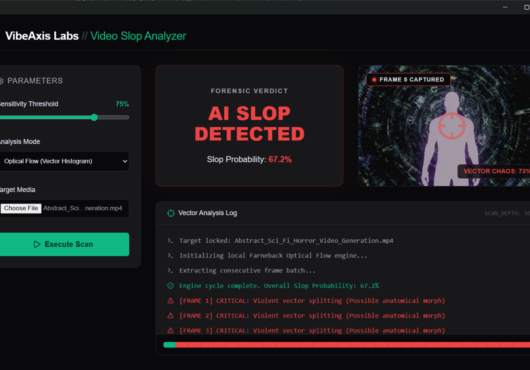
- Spot the Slop: You can’t fight what you can’t see. We built the Image Slop Index and the Fake Fast Detector to help you diagnose the specific strains of synthetic garbage clogging up the web. If it feels too fast, too generic, or too perfectly optimized, it’s probably slop.
- Scrub the Feed: You don’t need a complex software suite to clean up your digital life; you just need the right instructions. We published The Slop Squeegee Prompt—a specific methodology for resetting your algorithmic baselines and aggressively filtering out AI-generated noise. Treat it like a power-wash for your timeline.
Part 4: The Defensive Web
We have entered an era of “Privacy Nihilism.” The tech ecosystem is so aggressive, and the terms of service are so dense, that most people have simply given up. We blindly hit “Accept All Cookies” just to read a weather report. We let basic mobile apps track our GPS coordinates and harvest our contacts. And now, Silicon Valley is desperately trying to convince us to give “AI Agents” unfettered access to our calendars, inboxes, and operating systems under the guise of convenience. It is corporate scope creep disguised as a luxury. If you don’t actively defend your digital borders, the default setting of the modern web is total extraction.
The final step to surviving the Slop Economy is locking the doors.
Every app, platform, and newly minted “AI Agent” wants access to your data, your habits, and your wallet. They want to integrate seamlessly into your life so they can quietly extract value in the background. You have to build a defensive perimeter.
- Deny Unnecessary Access: Stop giving software the keys to your life just because it asks nicely. The Scope Bouncer Protocol is our mandatory rulebook for interacting with modern tech. It teaches you how to ruthlessly limit permissions and keep digital agents in their lane.
- Audit the Bleed: The Slop Economy thrives on you forgetting what you signed up for. Use the Subscription Saboteur Pro to track down the vampire apps draining your accounts, and run the Receipts Radar to keep the platforms honest about what they owe you.
- Exist Without Oversharing: You can still participate in the digital world without feeding your entire identity into a training model. Read up on our concept of the Proof Stamp: Existence Without the Overshare. It’s the ultimate guide to leaving your mark online while starving the data brokers.
Epilogue: Log Off or Boot Up
The internet isn’t going to fix itself. The platforms are too profitable, the AI is too cheap, and the engagement farms are too deeply entrenched.
But you don’t have to be a casualty of the Slop Economy. By auditing your attention, utilizing defensive tools, and understanding the dystopian mechanics running behind the scenes, you can carve out a space that actually serves you.
Equip your tools. Check your doomscroll tax. And if you ever want to see exactly how the enemy thinks? Boot up Vibeaxis and step into the terminal.