If you look at the search trends for game development in 2026, you will see a massive spike in a single, terrified question: “Are AI algorithms going to replace game developers?” Players hear “AI” and imagine a future where ChatGPT is hardcoded into the brains of the enemies they fight, generating dynamic, unbeatable tactics on the fly. Meanwhile, indie developers are watching the storefronts get drowned in a tidal wave of low-effort, AI-generated slop.
As a solo developer building a custom browser-based orbital defense engine called Divine Orbit, I spend a lot of time writing AI. And I’m here to clear up the confusion.
There is a massive, fundamental difference between Generative AI (what tech bros are trying to sell you) and Game AI (what actually makes video games fun). Here is how they work, why they are completely different, and why a Large Language Model makes a terrible video game boss.
What is Generative AI in Gaming? (The Slop Generator)
Generative AI (like LLMs or image generators) is a prediction engine. You feed it a prompt, and it mathematically calculates the most probable sequence of words or pixels to follow it.
Can you use Generative AI to make a video game? Yes. But you probably shouldn’t.
Generative AI doesn’t understand “fun.” It doesn’t understand pacing, frustration, or the psychological relief of narrowly surviving a boss fight. If you ask an LLM to design an enemy encounter, it will give you the most statistically average, predictable encounter imaginable. It generates the mean. It generates slop.
Smart indie developers aren’t using Generative AI to design their games. We use it as a highly competent autocomplete to write boring mathematical boilerplate so we can get back to hand-crafting the actual gameplay loop.
What is Traditional “Game AI”? (The Art of Losing)
When gamers talk about how “smart” the AI in Halo, F.E.A.R., or Left 4 Dead was, they aren’t talking about neural networks. They are talking about Finite State Machines (FSMs) and Behavior Trees.
Game AI is not intelligent. It is a meticulously crafted flowchart designed with one specific purpose: To lose to the player in the most entertaining way possible.
If I wanted to program an enemy that could easily kill you, I wouldn’t need an LLM. I would just write a script that reads your exact coordinates and spawns a bullet inside your head on frame one. But that isn’t fun.
Good Game AI is about telegraphing intent, creating blind spots, and giving the player a puzzle to solve.
- State Machines: An enemy is in an
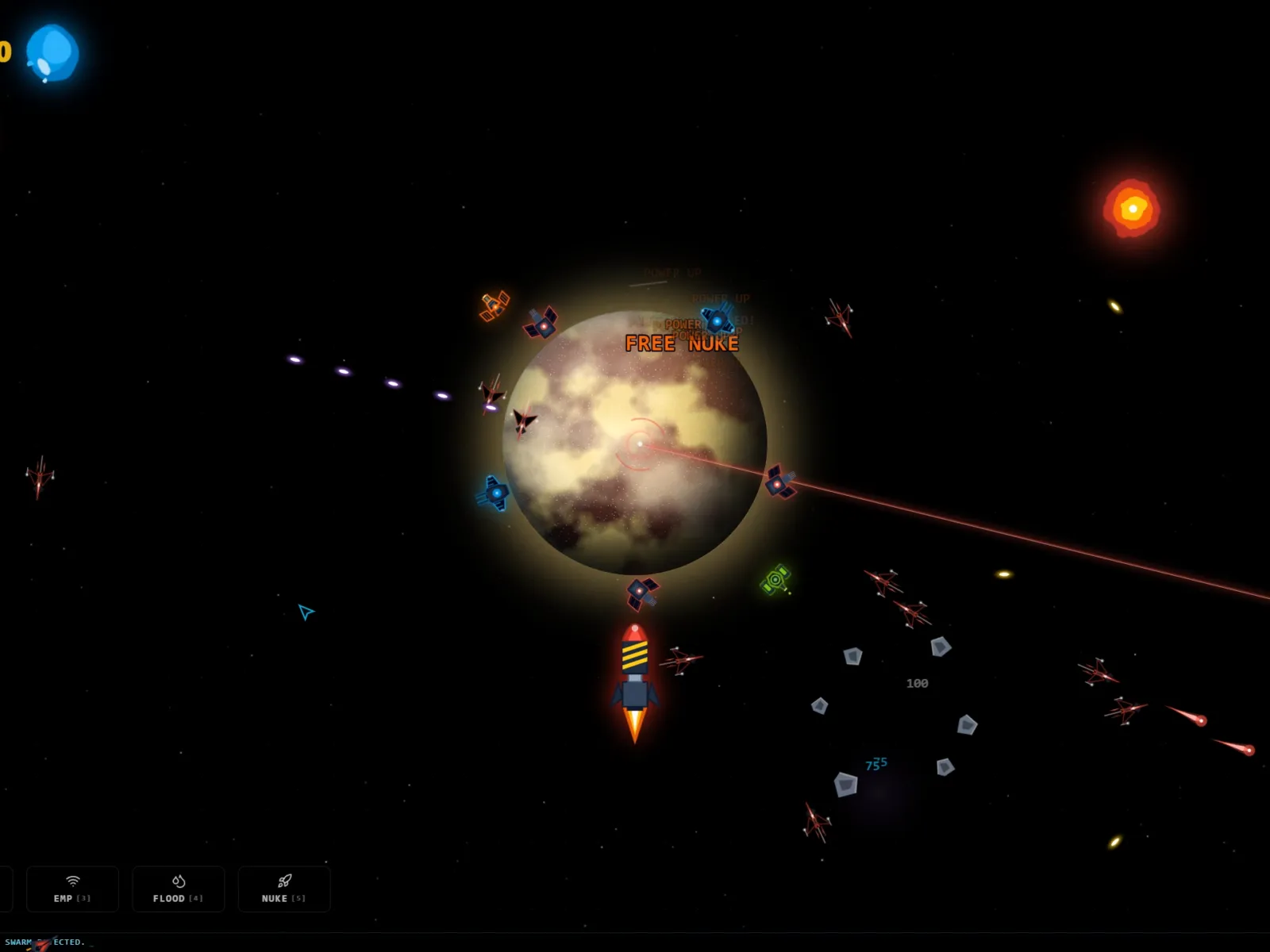
APPROACHINGstate. If the player gets too close, it switches to anATTACKINGstate. If the player shoots back, it switches to aREPOSITIONINGstate to dive behind cover. - Steering Behaviors (Boids): Have you ever wondered how a massive swarm of spaceships doesn’t just clump into a single, ugly pixel? It uses a decades-old math formula. In Divine Orbit, my Strike Drones check the distance of their neighbors 144 times a second. If they get closer than 80 pixels, they apply a slight mathematical “push” to their velocity vector. The result is a beautiful, organic, swarming movement. No machine learning required.
The “AI Director”: How Games Actually Manipulate You
The ultimate form of Game AI isn’t the enemies on the screen; it’s the invisible hand controlling them.
If you search “What is an AI Director in gaming?”, the best example is the system that revolutionized co-op shooters. An AI Director monitors the player’s “stress” levels (how much health they have, how much ammo they’ve spent) and dynamically adjusts the pacing.
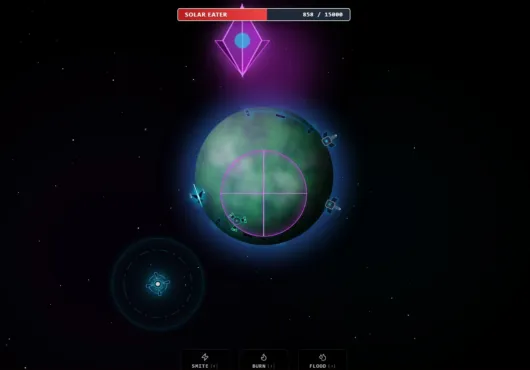
I built a custom AI Director for Divine Orbit to ensure the game never feels flat. It doesn’t use Generative AI. It uses strict, ruthless math.
Here is a glimpse under the hood of how the game decides when to try and crush you:
JavaScript
// The Divine Orbit Pacing Director
if (director.phase === 'STANDARD' && director.phaseTimer > 40000) {
    // After 40 seconds of standard wave defense, spike the tension.
    director.phase = 'SHOWCASE';
    director.phaseTimer = 0;

    // The Director selects a specific nightmare based on how long you've survived
    const deck = ['CRUISER_SWARM'];
    if (year >= 6) deck.push('PHANTOMS', 'COMBO_EMP_BREACH');
    if (year >= 8) deck.push('GAS_CLOUDS', 'ANOMALY_STORM');

    director.activeShowcase = deck[Math.floor(Math.random() * deck.length)];
}
The Director operates in three phases:
- Standard: A steady, manageable drip of asteroids and low-level ships.
- The Showcase: The Director unleashes hell for 25 seconds. It might spawn an
ANOMALY_STORMthat forces you to use specific God Powers to defuse elemental traps, or aCOMBO_EMP_BREACHwhere cloaked ships disable your satellites right as a massive swarm hits. - The Cooldown: Crucially, after the Showcase, the Director completely mutes the enemy spawners for 10 seconds. It intentionally gives you time to breathe, rebuild your grid, and feel the adrenaline wash away.
Generative AI cannot do this. It lacks the architectural context to understand the emotional rhythm of a 45-minute survival run.
Why Handcrafted AI is the Ultimate USP
The internet is currently filling up with identical, soulless games generated by people trying to make a quick buck. The best way to survive this flood isn’t to try and build the next generic Stardew Valley clone.
The best way to survive is to build something ruthlessly intentional.
When you play a game with tight, hand-crafted Game AI, you aren’t fighting a prediction algorithm. You are engaging in a high-speed conversation with the developer who built the rules.
If you want to experience what a hand-crafted AI Director feels like when it decides it’s time for your planet to die, you can play the free browser beta of Divine Orbit right here.