If you spend enough time reading social media, you might think game development in 2026 looks like this: A developer opens a prompt box, types “Make me a hit sci-fi orbital defense game,” hits Enter, and goes to sleep while a machine prints money.
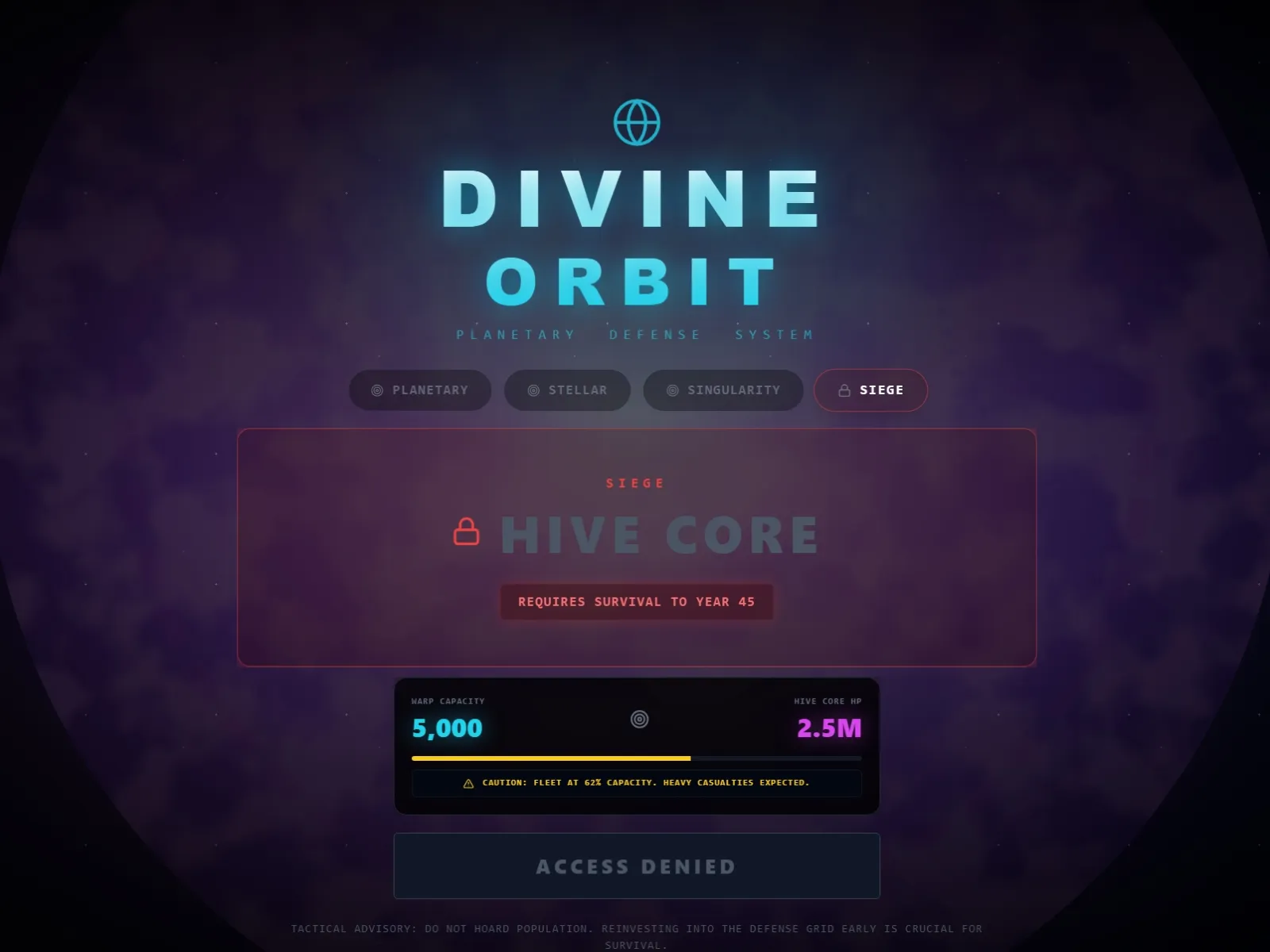
I am building a browser-based orbital defense simulator called Divine Orbit, and I am here to tell you that reality is wildly different.
There is a massive disconnect between what players think AI does in game development, and what developers are actually using it for in the trenches. AI is not an invisible game designer. It has no taste, no intuition for pacing, and absolutely no idea what makes a game “fun.”
What it is, however, is the world’s most hyper-competent, interactive Stack Overflow. Here is how indie devs are actually using AI right now, and why the human element is more important than ever.
The Myth of the “Magic Button”
Generative AI is essentially a massive prediction engine. If you ask it to design a boss fight, it will spit out the most mathematically average, predictable boss fight imaginable. It will give you a boss that attacks in three phases, flashes red when it’s angry, and spawns minions. It gives you slop.
The soul of a game—the exact timing of a hit-stop when a meteor cracks against a planetary shield, or the psychological weight of floating damage numbers—requires a human director.
AI cannot design Divine Orbit. But it absolutely helps me build it faster.
The Reality: AI as a “Rubber Duck” and Boilerplate Engine
In programming, there is a concept called “Rubber Ducking”explaining your broken code to an inanimate rubber duck on your desk until you realize where you screwed up. Today, AI is the ultimate rubber duck that can actually talk back.
Here is a real-world example from my codebase this week.
I wanted the nuclear impacts in Divine Orbit to look massive and cinematic. Initially, I was using React state to push expanding HTML <div> rings onto the screen every time a missile hit. It looked okay, but during late-game waves when 50 meteors were hitting the shield at once, the browser’s DOM recalculations were choking my frame rate to death.
I knew the architectural solution: I needed to rip the explosions out of React and build a high-performance, zero-allocation particle engine directly on an HTML5 <canvas>.
Writing a particle pool from scratch isn’t hard, but it is incredibly tedious. It requires hundreds of lines of boilerplate math, calculating deltas, recycling dead objects, and managing array indexes.
Instead of spending four hours typing out trigonometry, I explained my exact architectural plan to my AI assistant. Within seconds, it spat back the structural math for the exact loop I needed:
JavaScript
// The boilerplate math an AI can write in 2 seconds
const MAX_PARTICLES = 250;
const particlePool = Array.from({ length: MAX_PARTICLES }, () => ({
    active: false, x: 0, y: 0, size: 0, maxSize: 0, color: '#fff', life: 0
}));
let particleIdx = 0;

// ... recycling logic ...
const p = particlePool[particleIdx];
particleIdx = (particleIdx + 1) % MAX_PARTICLES;
The AI didn’t invent the visual style. I still had to go in and manually code the source-over blending, tune the exact opacity curves so it looked like searing plasma, and hook it up to my dynamic color system. But the AI saved me hours of typing raw array-management boilerplate.
What AI Actually Replaces
AI isn’t replacing game developers. It is replacing the friction of game development.
- It replaces syntax hunting: I don’t have to Google “Canvas 2D context radial gradient exact syntax” anymore.
- It replaces regex nightmares: Need to parse a weird string of save-data? The AI writes the regular expression instantly.
- It replaces blank-page syndrome: It gives you a dirty, rough draft of a system so you have something to immediately start fixing and molding to your vision.
Quality Over Slop
The barrier to entry for making a game has never been lower. We are going to see a flood of completely automated, low-effort content hit the storefronts.
But gamers aren’t stupid. They can feel when a game lacks a cohesive vision. They can feel when a boss fight was generated by a spreadsheet, or when a developer is just frankensteining mismatched, cheap assets together without caring about the final product.
AI helps me type the boring stuff faster, which means I get to spend 90% of my time designing the fun stuff. It makes hand-crafted indie games better, not obsolete.
If you want to see what a highly-tuned, zero-allocation particle engine actually looks like when a Titan-class meteor shatters against Earth, you can play the free web demo of Divine Orbit right now on VibeAxis.
And if you want to support human-crafted chaos, drop a Wishlist on our Steam Page!