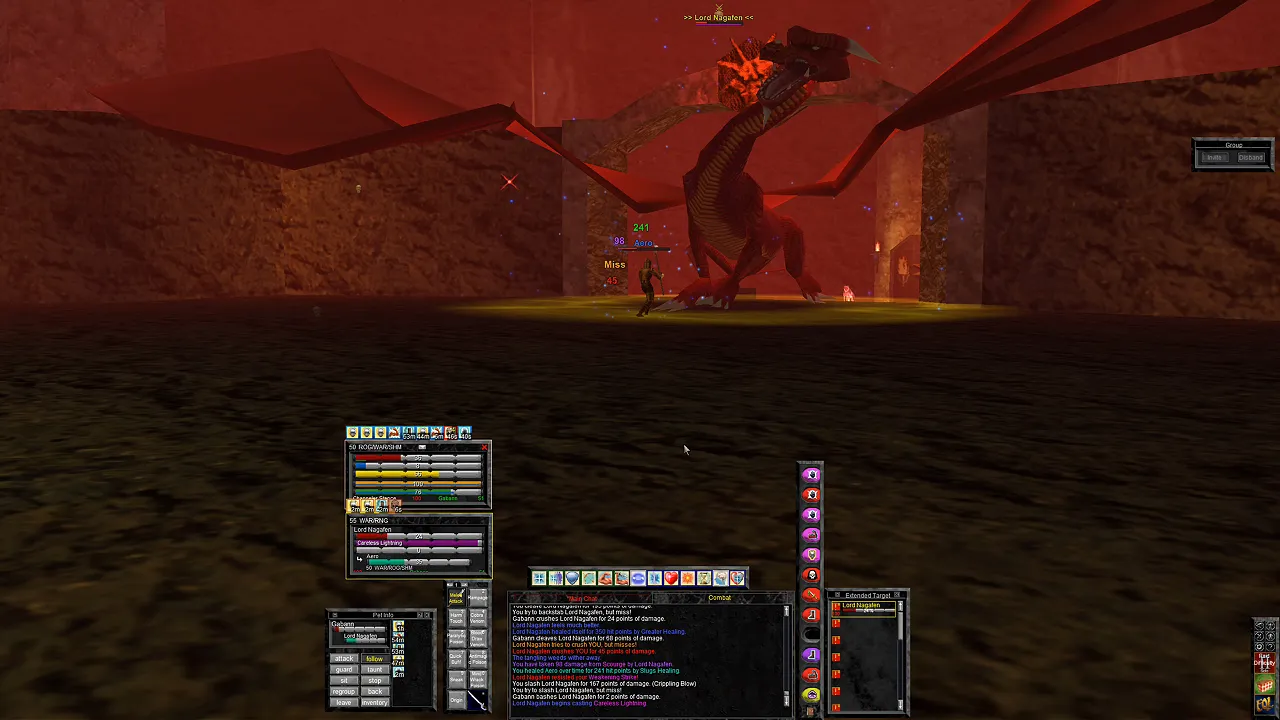
The marketing sells you a beautifully preserved, solo-friendly trip down memory lane wrapped in 1999 aesthetics. They boast about a staggering triple-multiclass system with 560 unique class combinations, promising “endless possibilities” for forging your hero. It sounds like a dream for casual exploration.
In reality, it is a giant illusion filled with developer traps.
The vast majority of those 560 combinations are mathematically broken underperforming dead-ends. The game presents itself as an open-ended RPG adventure, but under the microscope, it’s just a numbers game where the house forgot to calculate basic compounding multipliers. When you strip away the comforting coat of pre-Kunark nostalgia and look purely at the raw math of overlapping active abilities, stances, and the gear-enhancement matrix, the structural integrity of the entire game collapses.
You don’t need a group of four, and you certainly don’t need a raid of eight. If you know exactly which levers to pull, a single optimized build trajectory will trivialise the entire world of Norrath.
The 500 DPS Glass Ceiling
If you spend five minutes on the EverQuest Legends forums right now, you will see hundreds of players doing funny eyeball math, trying to theory-craft the ultimate glass-cannon DPS build. They are combining Rogues, Rangers, and Monks, chasing attack speed multipliers and backstab modifiers, convinced they can just melt bosses before taking damage.
They are walking directly into a massive developer trap.
What the game doesn’t tell you—and what the gear and economy limitations strictly enforce—is that there is a hard ceiling on damage output. No matter how you stack your classes, your damage effectively flatlines at roughly 500 DPS.
In a vacuum, 500 DPS sounds great. But when you hit the endgame and realize that the developer’s idea of “difficulty scaling” was just giving raid targets astronomical pools of HP, that 500 DPS becomes a drop in the ocean. You cannot out-damage the math. If a boss takes 10 minutes to kill at the absolute maximum possible DPS, playing a glass cannon doesn’t make you a hero—it makes you a corpse in the first 45 seconds.
The Sustain Meta: Why You Actually Can’t Die
When you play EverQuest Legends, you quickly realize why you feel immortal. It isn’t because the game is challenging, and it isn’t because you’ve mastered some high-level tactical play.
It’s because of the Stance System.
The developers didn’t build the stances into the foundation of the classes; they slapped them on top as a generic layer of “glue” that covers everything. Because the system is so generalized, there is massive, redundant overlap across every single class in the game.
Here is why this makes the game effectively impossible to lose:
This is why you can’t die. You aren’t “playing well.” You are just exploiting a mathematical layer that was crudely superimposed over the game. You could swap out half the classes in the game, and as long as you keep the “Tank/Priest” stance overlap, you would still be unkillable.
The Illusion of Choice
So, let’s revisit the marketing team’s favorite talking point: 560 unique class combinations.
To achieve the infinite sustain required to clear the endgame content, your build has two non-negotiable requirements:
With 3 Tanks and 3 Priests, the math suddenly looks very different.
| Core Requirement | Available Options |
| The Meat Shield | 3 (Warrior, Paladin, Shadowknight) |
| The Sustain | 3 (Cleric, Druid, Shaman) |
| Total Viable Cores | 9 |
There aren’t 560 ways to play EverQuest Legends. There are exactly 9 viable core templates.
What about your third class slot? It completely ceases to matter. Once your Tank/Priest engine is running, that third slot is purely flavor. You can throw an Enchanter in there for some utility, a Rogue for a marginal DPS bump, or whatever else you want to moderately challenge yourself with. The third class is just a hood ornament on a tank.
The Archetype Illusion: Why You Shouldn’t Care About Classes
The marketing for EverQuest Legends tries to paralyze you with choice. They tout “560 unique class combinations,” encouraging you to spend hours agonizing over which niche class to pick to get that 2% stat boost.
Stop. It’s a distraction.
If you look at the math, the game doesn’t operate on classes. It operates on exactly two archetypes. Every high-performing group, every successful solo farmer, and every “broken” build in the game fits into one of these two slots:
Your third slot? It’s just flavor text. It’s an ornament. Whether you pick a Rogue, a Wizard, or a Bard for that third slot, the outcome remains identical: you have a Tank, you have a Priest, and you have a character that can clear the zone. The “560 combinations” are just different ways to paint the same chassis.
The Stance System: The Engine That Shouldn’t Work
The core of this entire “Archetype” meta is the Stance System. In any other game, stances are a trade-off: you give up defense to gain offense, or vice versa.
In EQL, the system is just… silly.
Instead of acting as a limiter, the current stance mechanics act as an infinite resource battery. They are clearly intended to gate your power, but they function as a perma-buff that allows for endless engagement. The game doesn’t reward tactical stance-dancing or deep strategy; it rewards the player who realizes that the game’s “hard” mechanics are actually just free passive bonuses.
Once you realize the Stance System is the only lever that actually matters, the game stops being an RPG and starts being a calculator.
The “Training Wheel” Trap: Why the Game is Designed to Fail
We’ve broken down the math of the Stance System and the industrialization of the platinum economy, but there is one final, uncomfortable truth about EverQuest Legends: The “Training Wheel” zones are not an accident.
When you look at the design of the early-game, it isn’t balanced to foster growth. It is balanced to provide an immediate, dopamine-heavy “power fantasy” for hyper-casuals.
Look at the mechanics of these zones:
It works perfectly for the first week. The player feels powerful, they’re hoarding loot, and they’re interacting with the shop. But the moment the player outgrows the “training wheels”—when the mobs stop dropping enough vendor trash to make the bag-space purchase feel “worth it,” or when the difficulty spikes enough to require actual mechanics—the power fantasy shatters.
The player realizes there is no depth, no endgame, and no reason to stay. They quit, move to the next title, and the publisher simply looks for the next wave of casuals to fill the training wheel zones.
The Industrialized Loot Loop: Why You’re Just a Trash Collector
The Stance System does more than make you immortal; it turns the entire game into a mindless, high-speed treadmill. Because your stances provide permanent sustain, you never have to stop to rest or manage your resources. But the real “trap” isn’t the stances themselves—it’s how the developers paired that immortality with the economy.
It’s a closed-loop system designed to turn you into a glorified janitor:
You aren’t playing an RPG; you are interacting with a trash-collection simulation. That is why the Mistmoore farm is the ultimate example of this design: you pull the room, the stance-engine keeps you topped off, you hit one button to dump the loot, and you repeat until your bags are full.
The game doesn’t want you to “master the economy” or “play the market.” It wants to keep you in a dopamine loop where you feel productive because you’re hoarding vendor trash, all while the developers wait for you to realize your inventory is full and pull out your credit card to buy more space.
Conclusion: Hitting the Week Two Wall
If you follow this guide, you will be unstoppable. By utilizing the Tank/Priest archetype, ignoring the class-traps, and weaponizing the Stance System to farm Mistmoore for 400p a pull, you will tear through the content.
But that brings us to the ultimate, unavoidable truth of EverQuest Legends: You are going to finish the game very, very quickly.
The developers built a math engine, not a world. They created an “unbalanced mess” that is fun for a week precisely because it is so easy to break. Once you’ve optimized your build, maxed your tradeskills, and realized that “Difficulty Scaling” is just a lazy way to add HP to mobs, you will look for the next challenge.
And you won’t find one.
By Week Two, the “endgame” will be empty. You’ll be standing in the best gear in the game, with a bank full of platinum, realizing that the “560 class combinations” were just a way to distract you from the fact that there was no game at the end of the tunnel.
EverQuest Legends is a fascinating math simulator. Enjoy the week of power-tripping—just don’t expect it to last.