You spent three months coding a complex armor-penetration algorithm. You factored in velocity, material density, and distance drop-off. It is a mathematical masterpiece.
You hand the game to a playtester. They shoot an enemy. The enemy’s health bar quietly goes down by 12%. The playtester yawns, closes the window, and says, “The combat feels kind of floaty.”
You want to scream. The combat isn’t floaty; it’s functionally perfect. But here is the brutal reality of the indie game market: Players do not care about your math. They care about their dopamine. If you want to know why your Steam page has zero wishlists, start by looking at how your game feels. If your game is functionally perfect but psychologically silent, you are losing the attention war. Here is why you need to swallow your developer ego and give the player the “juice.”
The Spreadsheet Trap
The reason so many indie games feel dead is that developers spend 90% of their time building a spreadsheet and 10% of their time building a toy.
When you code a combat system, you are looking at raw variables. You see the baseDamage multiplying against the critChance. You understand the weight of the hit because you literally wrote the formula.
But the player does not have access to your source code. The player is sitting on the other side of a pane of glass, entirely reliant on the sensory feedback you provide. If you do not translate your beautiful backend math into aggressive front-end sensory data, the math functionally does not exist. A perfectly calculated 5,000-damage critical hit that makes no sound and has no visual impact feels significantly weaker to a player than a badly calculated 10-damage hit that shakes the screen and flashes the screen white.
Developer Ego vs. Player Attention
There is a toxic mindset in indie development that adding “juice”—screen shake, flashing colors, hit-stops, and floating damage numbers—is a cheap trick for mobile games. Developers want their complex mechanics to speak for themselves.
But game development is a staring contest between your ego and the player’s attention span. When a player clicks a button, they are depositing their most valuable currency (their time) into your machine. If that machine doesn’t immediately dispense a biological reward, they will take their currency elsewhere.
Floating damage numbers aren’t a cheap trick; they are a psychological handshake. When a player hits an enemy and a massive, bright yellow “CRITICAL: 1,500” pops out of their skull, it triggers an instant micro-dose of dopamine. It validates their decision to press the button. It tells their brain, “You did a good job.” ### Case Study: Faking Impact Without Tanking the Frame Rate
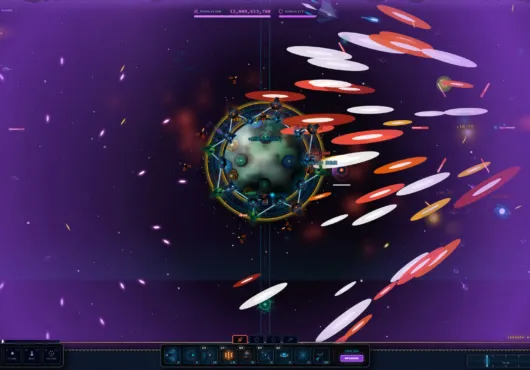
When we were building the combat engine for our hardcore sci-fi action-RTS, Divine Orbit, we ran into this exact problem. We had a massive, chaotic simulation running hundreds of enemies on the screen at once. But early on, when a player dropped a tactical nuke on a swarm of Void Ticks, it just felt… flat. The enemies disappeared, but there was no weight to the action.
We didn’t rewrite our damage formulas. We just hacked the player’s brain using three incredibly cheap tricks:
The 50-Millisecond Hit-Stop When a massive hit lands, we literally break the physics engine for a fraction of a second. We drop the game’s timescale to 5% (timeScaleRef = 0.05) for exactly 50 milliseconds. The game physically hangs in the air for a split second before the explosion triggers. This mimics the feeling of physical resistance—like an axe biting into heavy wood.
Quadratic Screen Shake Linear screen shake looks like a cheap camera glitch. Quadratic screen shake feels like an earthquake. By squaring the “trauma” value of an impact before applying it to the camera offset, the screen snaps violently on the initial hit, then stabilizes rapidly.
Zero-Allocation Floating Text In a web-based game like Faultline.exe or Divine Orbit, spawning hundreds of React components for damage numbers will instantly melt the browser’s garbage collector. Instead, we built a zero-allocation text pool. We pre-allocate an array of 150 text objects and just cycle through them, updating their X/Y coordinates and painting them directly to a raw HTML5 Canvas.
The result? The player can wipe out 50 enemies at once, triggering a massive hit-stop, a blinding white screen flash, and a fountain of gold “+150 SD” floating numbers, all while holding a buttery smooth 144Hz. (If you want to see the exact code for how we bypassed React to do this, check out our guide on building a custom zero-loading web game engine).
Visual Telemetry: The Illusion of Min-Maxing
Beyond the dopamine hit, floating damage numbers serve a critical UX (User Experience) function: Actionable Telemetry.
Modern players have been conditioned by decades of RPGs to optimize their builds. If you hide the exact damage numbers behind a silent health bar, you are robbing the player of the ability to experiment.
When a player swaps a kinetic rifle for a thermal laser, they want to see the math change. They want to see the white “45” turn into a glowing orange “82”. The floating text isn’t just visual noise; it is the player’s diagnostic tool. It allows them to reverse-engineer your armor-penetration algorithm without ever looking at your code. By providing clear, color-coded floating text (White for normal, Yellow for crits, Gray for resisted), you turn the act of dealing damage into a continuous, rewarding puzzle.
The Audio Anchor
Finally, you cannot talk about “Game Feel” without talking about the audio pipeline. Human biology processes audio significantly faster than visual data. Before the player registers the floating damage number or the screen shake, their ears have already decided if the weapon is powerful.
If you attach a massive visual explosion to a generic .wav file of a pop-gun, the player’s brain will experience cognitive dissonance. The audio must anchor the visual. In our games, we don’t just play a sound; we manipulate it dynamically. When a critical hit lands, we slightly lower the pitch of the impact sound and boost the low-end equalizer frequencies. It creates a subconscious, visceral “thud” that perfectly matches the oversized yellow text on the screen.
Stop Demanding Attention. Engineer It.
Functionality is the baseline. “Juice” is the currency.
If your gunshots sound like staplers, if your enemies die without a visual pop, and if your UI is silent, your game is dead on arrival.
You have to proactively validate the player’s time. Make the screen shake. Make the numbers fly. Give them the dopamine they are asking for, so they stick around long enough to appreciate the brilliant, complex game you actually built underneath it all.