You just spent four days in Premiere Pro. You found the perfect, royalty-free orchestral track. Your trailer opens on a pitch-black screen. A single piano note plays. Slowly, elegant white text fades in: “In a world broken by the Void…” It’s cinematic. It’s emotional. It’s a masterpiece.
It is also going to absolutely tank your Steam page.
If you want to know why your indie game has zero wishlists, start by looking at your trailer analytics. The harsh reality of the indie game market is that players do not care about your lore until they care about your mechanics. If you hide your gameplay behind dramatic camera pans and fading text, the market will assume you are hiding a bad game.
Here is the exact data on why you need to stop acting like a movie director, burn your cinematic intro, and start following the 5-Second Rule.
The Analytics of Apathy (The Steamworks Reality Check)
If you think a slow, cinematic build-up works, open your YouTube Studio dashboard and look at the Absolute Audience Retention curve.
When a trailer opens with two seconds of a developer logo, followed by three seconds of panning environment shots, the retention graph looks like a cliff face. You lose 60% of your audience before a single game mechanic is shown.
But it’s worse on Steam. You have to design for the Steam Discovery Queue and the Hover-to-Play mechanic. When a user hovers their mouse over your capsule art on the Steam homepage, the platform silently auto-plays the first few seconds of your primary trailer.
Think about the math of the Steam ecosystem. The algorithm is serving your game to a user who is rapidly scrolling through a list of 50 other titles. If your trailer opens on a black screen fading into an esoteric quote, the micro-player shows them nothing but a black box. They don’t wait for the text to appear. They don’t click the capsule. They keep scrolling. Your Click-Through Rate (CTR) flatlines, and the Steam algorithm quietly buries your game for failing to convert impressions.
The “Mute Scroll” Reality Check
Developers edit trailers in a quiet room with $300 studio headphones strapped to their heads. They meticulously time the scene transitions to match every bass drop and cymbal crash.
But players don’t watch trailers in a studio. They watch trailers on mute while sitting on the toilet, waiting in a multiplayer matchmaking queue, or hiding their phone under a desk at work.
If your trailer relies on a dramatic audio swell to build tension, it is failing 80% of your audience. Visuals are the only universal language. If a player watches the first five seconds of your video in total silence and cannot instantly figure out what their hands will be doing on the keyboard, they are going to close the tab.
You are not Christopher Nolan. You are selling a digital toy. Show them how the toy works.
The Micro-Genre Parsing Protocol
Why exactly five seconds? Because the human brain uses visual heuristics to categorize data instantly. When a player clicks a game trailer, their brain is desperately searching for visual anchors to answer one question: “Is this my type of game?”
They don’t read your Steam tags; they look at your User Interface (UI).
- An isometric camera with a hotbar at the bottom? ARPG. Like Diablo.
- A first-person camera with a floating gun and a health number in the corner? Boomer Shooter.
- A top-down grid with floating resources? RTS or City Builder.
If you hide your UI to make the trailer look “more cinematic,” you are actively preventing the player from parsing your genre. Never hide the UI in your opening hook. Give the player the visual data they need to file your game in their mental library.
The 5-Second Trailer Template
Stop overcomplicating your marketing. The most successful indie trailers on Steam follow a ruthlessly efficient, almost brainless formula. Cut the fluff and structure your timeline like this:
- Seconds 0-1 (The Anchor): Immediate, high-action gameplay with the UI fully visible. No logos. No ESRB warnings. No black screens.
- Seconds 1-3 (The Core Verb): Show the player exactly what they will be doing 90% of the time. If it’s a platformer, show a perfect jump sequence. If it’s a shooter, show a satisfying headshot.
- Seconds 3-5 (The Escalation): Introduce the hook. Show the massive boss, the swarm of enemies, or the unique mechanic that separates your game from the slop.
- Seconds 5+ (The Details): Now, and only now, can you drop in a quick text card or show off your cool environment art. You have earned their attention; now you can explain the context.
Case Study: Engineering Chaos at Vibeaxis
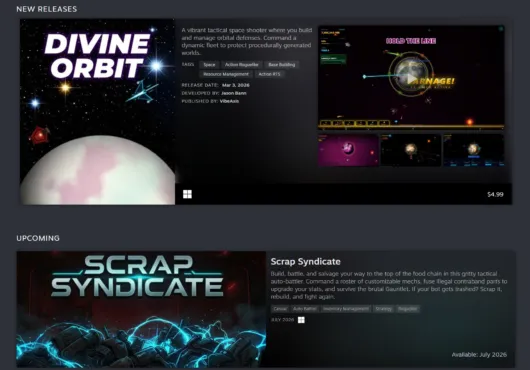
When we cut the trailer for our hardcore Action-RTS, Divine Orbit, we knew we couldn’t waste time on deep-space lore. The game is about overwhelming, screen-shattering APM (Actions Per Minute) survival.
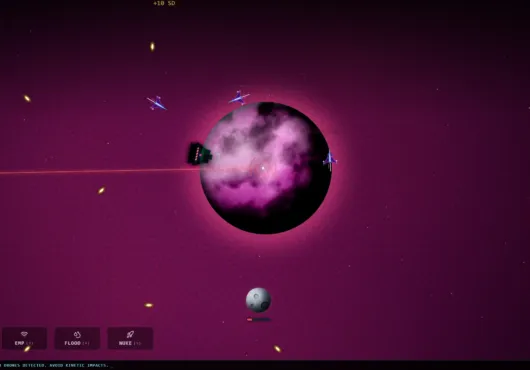
The trailer does not start with a panning shot of a quiet nebula. It starts with the grid already actively under attack. No fading text, just immediate, raw footage of Vanguard interceptors swarming the screen, Omega Cannons firing, and the UI flashing warnings.
We applied the exact same philosophy to our terminal-hacking survival game, Faultline.exe. Text-based games are notoriously hard to market, so we didn’t try to make it look like a Hollywood movie. We showed the raw terminal booting, the localized threat warnings flashing red, and the frantic, high-speed typing required to survive. We sold the stress of the mechanics in the first three seconds.
Confidence is Visible
Hiding your gameplay is the ultimate tell of an insecure developer. Subconsciously, players know that if a trailer is 90% cinematic drone shots, animated cutscenes, and fading text cards, the actual game probably isn’t very fun to play.
Trust the engine you built. Drop the player right into the action. If you respect their time by showing them exactly what you are selling in the first five seconds, they will reward you with a wishlist.
(If your trailer is perfect but nobody is clicking on it in the first place, your capsule art might be the problem. Check out our full guide on the 5 Reasons Your Steam Page Has Zero Wishlists to fix your funnel).