The graveyard of Steam is packed with five-year passion projects. You know the story: a solo developer quits their job, builds a massive, sprawling RPG from scratch, launches it to zero fanfare, and completely burns out.
If you are researching the most common pitfalls for indie developers, you will usually find the same generic advice: “Market your game earlier,” or “Make your capsule art better.”
But the reality is much harsher. The standard indie development model is fundamentally broken. It relies on a “Launch Day or Bust” mentality where 100% of a studio’s risk is tied to a single, isolated product. To survive and actually build a scalable business in modern game dev, you have to stop building isolated games. You need to build an ecosystem.
The Worst Mistake Game Developers Make: The Single-Game Trap
When you build a single game, your marketing funnel is a leaky bucket. You fight tooth and nail for every single impression on Twitter, Reddit, or YouTube. If you manage to get a player to click your Steam link and they decide the game isn’t exactly their specific niche, they bounce.
That marketing effort is permanently lost. You paid for the click—either with money or hours of your life—and it evaporated.
Worse, when you finally finish that game and start your next project, you are back at square one. You have a brand new codebase, a new Steam page with zero traffic, and you have to re-educate the market on who you are. This reset is one of the leading causes of indie game developer burnout.
The Solution: Building an Indie Ecosystem
Instead of betting everything on a single roulette spin, treat your studio like a tech platform. This is the “Indie Flywheel” approach.
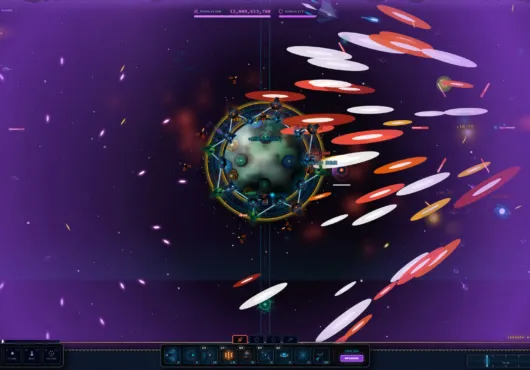
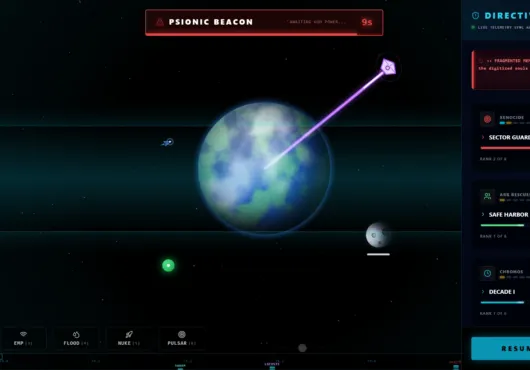
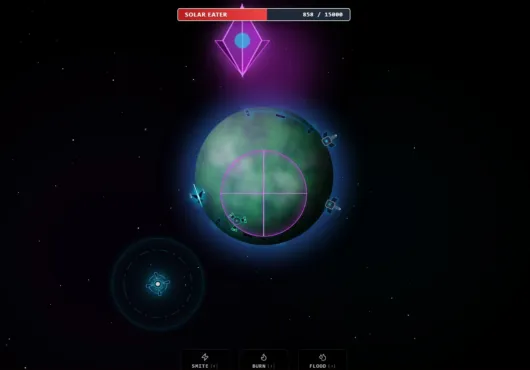
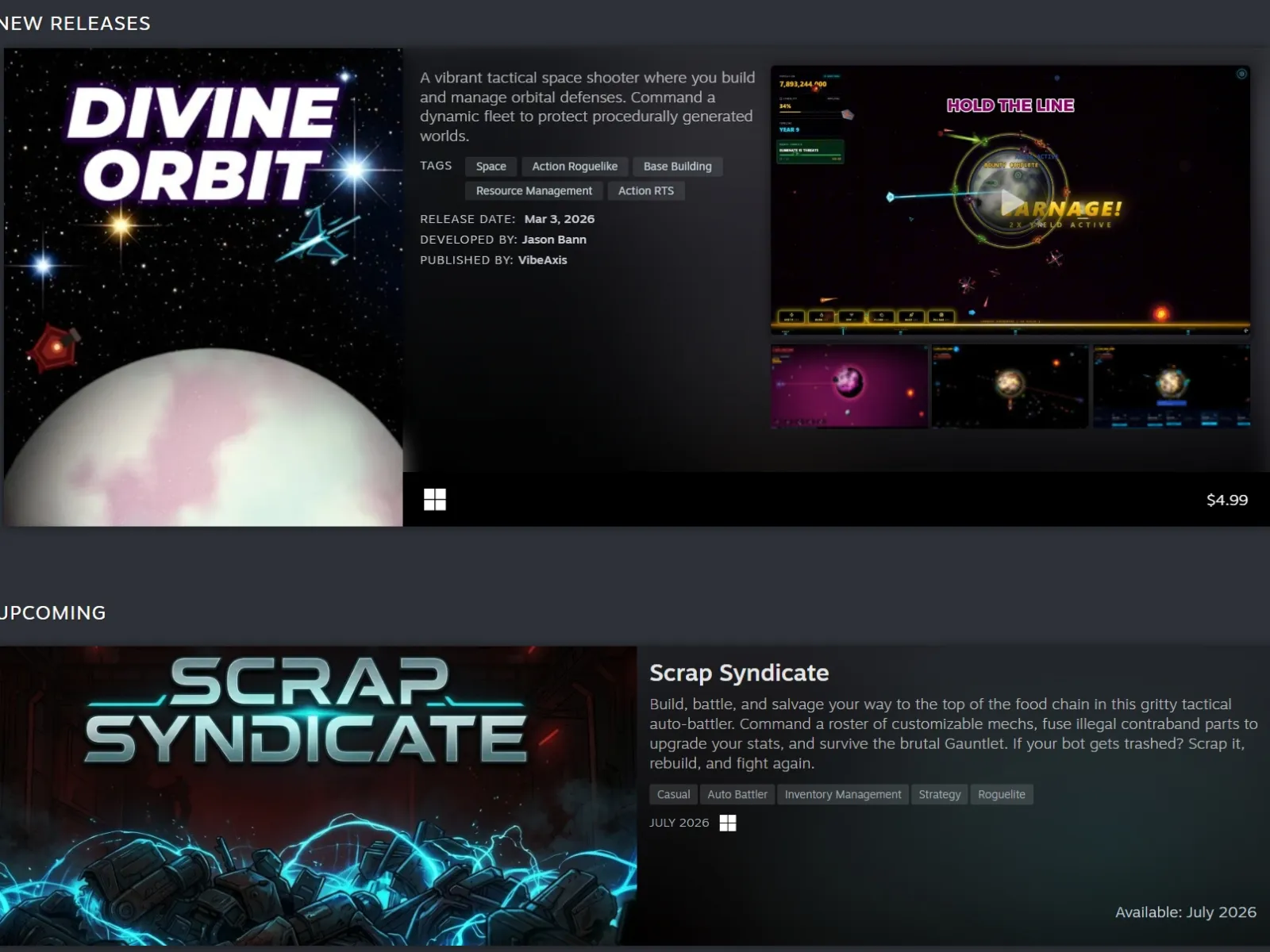
For the Divine Orbit Cinematic Universe (DOCU), we didn’t just build a single game. We established a high-performance development philosophy. Every game we build is bespoke, but they are all connected to power an interlocking portfolio:
- Divine Orbit: A high-speed orbital defense simulator.
- Scrap Syndicate: A chaotic, auto-battler spinoff.
- Stellar Architects: A highly technical, tactile command-deck experience.
They don’t share a copy-pasted generic engine. They share a hardcore engineering philosophy. They share lore. And most importantly, they share traffic.
How to Get More Steam Traffic: The “Other Product Pages” Metric
When you build an ecosystem, your games stop competing with each other and start feeding each other.
If you look at standard Steam analytics for a standalone indie game, traffic comes from the Discovery Queue or Direct Search. But when you look at the analytics for an ecosystem, a massive new traffic source appears: Other Product Pages.
If a player lands on Divine Orbit and decides they don’t want a defense simulator, they don’t just leave our ecosystem. They scroll down to the “More from this developer” section, see the tactile UI of Stellar Architects, and click over. We consistently see nearly 10% of our total daily traffic flowing organically between our own games.
A Common Indie Dev Pitfall: Starting the Tech Stack from Scratch
One of the biggest reasons indie games take too long to make is that developers don’t carry their technical breakthroughs forward. To build a flywheel without becoming a cheap “asset flipper,” you don’t just copy-paste your code—you abstract your learnings.
Because our games are built on raw web tech, we carry our architectural DNA from project to project. Every game in the DOCU gets its own bespoke engine built from the ground up, but they all share the exact same “Zero-Allocation” philosophy.
We aren’t just swapping out enemy sprites on a unified engine block. Instead, we carry our mathematical breakthroughs—like our spatial partitioning grids and high-performance React UI rendering—into every new build. When we figure out how to completely bypass the JavaScript Garbage Collector in Divine Orbit, we bake that core knowledge directly into the foundation of Scrap Syndicate.
When we optimize our vector math in one project, the architectural blueprint for that optimization is immediately deployed in the next one. We aren’t maintaining three disjointed, chaotic ideas; we are evolving a single, high-performance engineering standard across an entire universe.
Game development is too brutal to reinvent the wheel every single time. Establish a bulletproof technical philosophy, build a cohesive universe, and let the ecosystem do the heavy lifting.
The Trap of Scope Creep in Game Development
If there is one phrase that strikes fear into the heart of a solo developer, it is “Scope Creep.” You start by designing a simple 2D platformer, and three months later, you are trying to code a branching dialogue system, a day/night cycle, and an RPG crafting tree.
Scope creep in game development is the number one reason games are never finished. It often leads developers straight into the Fiverr Frankenstein trap—outsourcing mechanics they don’t understand just to cram more features into a bloated game.
But when you build an ecosystem rather than a standalone game, scope creep naturally resolves itself.
In a traditional development cycle, every cool new idea you have gets shoehorned into your single project because you feel like it’s your only chance to show it off. In the Indie Flywheel, if you come up with an incredible mechanic for an auto-battler while building your defense simulator, you don’t force it into the defense simulator. You spin it off into a “Scout Game.”
Because you already have the custom engine, the UI framework, and the rendering pipeline built, spinning up a new prototype takes days, not months. The ecosystem model gives your ideas room to breathe without bloating your primary project.
Cross-Pollinating Game Mechanics (The Prototyping Vault)
When you aren’t restricted to a single monolithic game, failure becomes a resource.
During development, you will inevitably code mechanics that are objectively fun, but fundamentally break the pacing of your current project. Traditionally, you would just delete that code. In an ecosystem, that code goes into the prototyping vault.
For example, if we design a wildly unbalanced, high-variance probability matrix that ruins the strategic purity of a command-deck game, we don’t throw it away. We isolate that math, wrap a new UI around it, and suddenly we have the foundational architecture for a completely different title, like Ratio Royale.
Your discarded ideas from your flagship game are the perfect seeds for your next rapid-development spinoff.
Training Your Audience (The Shared Vibe and UI)
One of the hardest hurdles in indie game design is the onboarding phase. Players hate tutorials. If they have to spend 20 minutes learning your UI, they will refund the game.
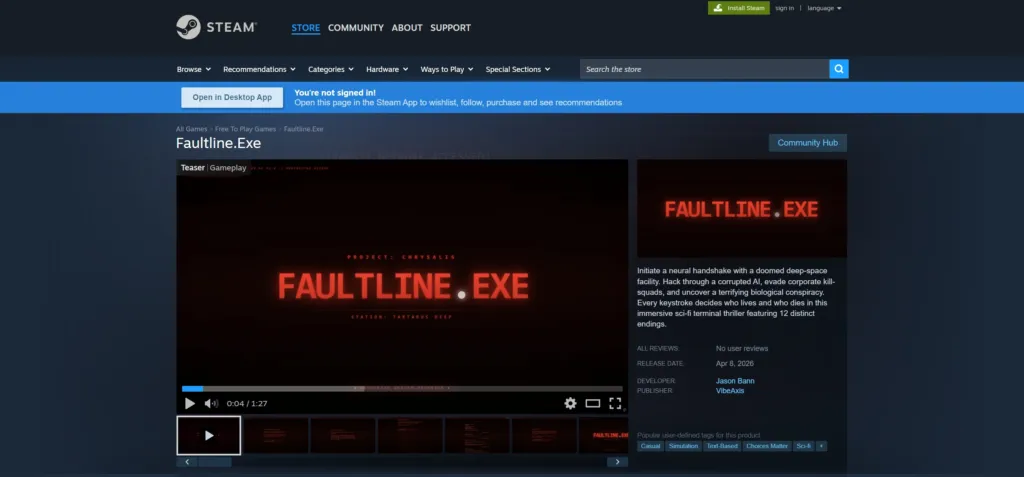
An ecosystem solves this by passively training your audience. When we designed Faultline.exe, we intentionally built it with zero tutorials, forcing players to intuitively learn our specific style of terminal-hacking UI.
Because they learned that visual language, when those same players boot up Terminal Descent or step into the forensic UI of Cryo Coroner, the onboarding friction is entirely gone. They already know how our menus feel. They know how our audio cues work. The shared vibe across your portfolio means your players instantly feel “at home” the second they launch your newest game.
How to Market an Indie Game with No Budget (The Lead Magnet Strategy)
Another massive pitfall is the marketing phase. Developers constantly search for how to market an indie game with zero budget, hoping to find a secret hashtag or a magical Reddit formula.
The reality is that social media algorithms suppress outbound links. Twitter and TikTok do not want users leaving their platforms to go to Steam. Trying to market a paid game from scratch to a cold audience is incredibly expensive and exhausting.
Instead, the most powerful zero-budget marketing tool is a Lead Magnet. In the software world, companies give away free tools to capture emails. In the indie game world, we use free browser games and high-value demos.
For our ecosystem, titles like Void Wager serve as high-quality, frictionless entry points. We aren’t asking a cold audience to open their wallets; we are asking them to click a link and instantly test their skills. Once they are hooked by the core loop and the tactile UI, the ecosystem takes over. Our “Other Product Pages” traffic funnels those highly engaged players directly to our premium titles.
You don’t need a massive ad budget if your portfolio inherently markets itself.
Custom Game Engine vs Unity or Godot: Escaping the Bloat
When developers search for the best engine for 2D indie games, the debate usually centers around Unity, Godot, or Unreal. But there is a massive blind spot in the indie community regarding web technologies.
Most commercial engines are designed to be “everything for everyone.” They carry an immense amount of overhead, heavy asset registries, and complex physics solvers that a 2D game simply does not need. This bloat leads to the micro-stutters and 10-second loading screens that plague modern indie releases.
This is why we chose the hardest route: writing a custom engine from scratch.
By abandoning the standard commercial engines, we were able to build a highly specialized architecture using React and WebGL. Our UI isn’t a clunky Canvas overlay; it’s a snappy, tactile React frontend that feels like interacting with actual hardware. Our game loop utilizes Zero-Allocation Memory Pooling, completely bypassing the Javascript Garbage Collector.
When your game logic doesn’t have to fight against an engine’s generalized framework, you achieve absolute control. You can render thousands of entities at 144Hz, and when the player dies, the scene resets in 0.5 seconds.
Building a custom engine requires heavy upfront architectural planning, but once the foundation is laid, it becomes the ultimate unfair advantage for your studio.
The Ultimate Steam Next Fest Strategy: Deploying the “Scout Game”
If you are researching how to get wishlists from Steam Next Fest, you need to understand the psychology of the festival player. Next Fest is a meat grinder. It is the ultimate attention economy.
During the event, a typical Steam user will download 15 to 20 different demos. They are not looking for a slow-burn, 40-hour narrative experience. They are going to give your game exactly 3 to 5 minutes to prove itself. If they hit a wall of text, a boring tutorial, or clunky UI, they will immediately uninstall and move to the next demo on their list.
This is where the traditional indie developer makes a fatal mistake: they send their heaviest, most complex flagship game to the festival, hoping players will “push through” the learning curve.
When we looked at our ecosystem—Divine Orbit (hardcore defense simulator), Stellar Architects (deep tactical command deck), and Scrap Syndicate (chaotic auto-battler)—the choice of which game to push into Next Fest was entirely intentional. We sent the auto-battler.
Winning the Attention Economy with High-Dopamine Loops
We didn’t send Scrap Syndicate to Next Fest because it’s our biggest game; we sent it because it is the perfect Spearhead.
Auto-battlers thrive on immediate gratification and low upfront friction. Within 60 seconds of booting the demo, the player is already watching bots clash, hearing the heavy, tactile UI sound effects, and experiencing the massive dopamine rush of a “1-HP comeback.” We engineered the variance in the combat specifically to create near-miss scenarios that hook the player instantly.
Because the loop is so tight and satisfying, the player doesn’t bounce after 5 minutes. They play for 45 minutes. They finish the demo, and because they had a great time, they hit the wishlist button.
Converting Festival Traffic into Ecosystem Value
Here is where the Indie Flywheel turns a successful Next Fest demo into a massive studio victory.
If we were a traditional studio, those wishlists would only apply to a single $5 auto-battler. But because Scrap Syndicate is tied to our Developer Homepage and shares a visual identity with our other titles, it acts as a massive funnel.
When thousands of players play the Scrap Syndicate demo during Next Fest, a significant percentage of them will click our studio name. They will see Stellar Architects—a game they might not have had the patience to learn during a crowded festival, but one they are highly interested in buying later now that they trust our mechanical design and technical polish.
By sending our lowest-friction “Scout Game” into the Next Fest meat grinder, we gather the maximum amount of algorithmic momentum, which then trickles down and funds the visibility of our deeper, more complex flagship titles. You don’t bring a slow-moving battleship to a knife fight; you bring your fastest, sharpest loop.
Stop Treating Steam Like a Lottery
The harsh truth of indie game development is that building the game is only 30% of the job. The other 70% is system architecture, market positioning, and managing your algorithmic footprint.
If you spend five years building a single game, relying on commercial engines that bloat your loading screens, and praying that the Steam algorithm randomly blesses you on launch day, you are not running a business. You are buying a lottery ticket with your life savings.
Take control of your tech stack. Abstract your code so you aren’t starting from scratch every time. Build smaller, interconnected titles that share traffic. And most importantly, respect the player’s time by giving them zero-allocation, high-performance gameplay that gets straight to the point.
Build an ecosystem, and let the flywheel do the work.
Melt the screen. Not your GPU.
Experience the Flywheel in action. Jump directly into our zero-loading, high-speed ecosystem and see the custom engine pushing thousands of entities.