You get home after work, queue up for a few relaxing matches, and now every lobby feels like the World Championship final.
If you’ve played Call of Duty, Apex Legends, or Fortnite recently, you’ve felt the wall. You aren’t imagining it, and you didn’t suddenly get worse at video games overnight. What you are experiencing is the silent machinery of modern lobby balancing—commonly lumped under the broad term SBMM (Skill-Based Matchmaking).
It is the loudest complaint in Modern Warfare 4’s launch week: a campaign players love, and multiplayer lobbies that feel like a second job. Here is a breakdown of what SBMM actually is, how it functions behind the scenes, and why it transformed casual online gaming into a relentless grind.
What is SBMM in Gaming?
Skill-Based Matchmaking (SBMM) is an algorithmic system that groups players in online multiplayer matches based on their estimated skill level rather than connection quality or pure ping.
In traditional online gaming (think Call of Duty 4 or early Halo), lobbies were largely regional and connection-based. A single match might include one total beginner, four average players, and one unhinged veteran dropping 50 kills. Matches were unpredictable, chaotic, and varied.
SBMM replaces randomness with mathematical equilibrium. The system tracks your performance metrics continuously to assign you an internal skill rating, often referred to as MMR (Matchmaking Rating).
Core Metrics Tracked by SBMM
K/D Ratio & Score Per Minute (SPM): How efficiently you eliminate targets and score points.
Win/Loss Ratio: Your history of securing match victories.
Recent Performance Windows: Many modern algorithms weight your last 5 to 10 matches significantly higher than your lifetime career stats.
Accuracy & Movement Inputs: High-tier systems track headshot percentages, APM (actions per minute), and movement habits.
Why Does SBMM Feel So Bad to Play?
If SBMM is designed to make matches “fair,” why do millions of players despise it? The frustration boils down to three distinct mechanical consequences:
1. The Death of the “Casual” Match
When every player in a lobby is calibrated to the exact same skill ceiling, there are no relaxed games. You cannot try a fun, sub-optimal weapon build or play passively with friends while chatting. The moment you ease up, players who are treating the match like an tournament will run you over.
2. The Penalty for Playing Well
In older systems, improving at a game meant you won more matches and felt your skill growth in real time. Under strict SBMM, getting better just triggers the algorithm to push you into a harder bracket. Success isn’t rewarded with a fun victory; it’s punished with an immediate spike in difficulty.
3. SBMM vs. EOMM (Engagement-Optimized Matchmaking)
This is where the story gets more complicated, and more interesting.
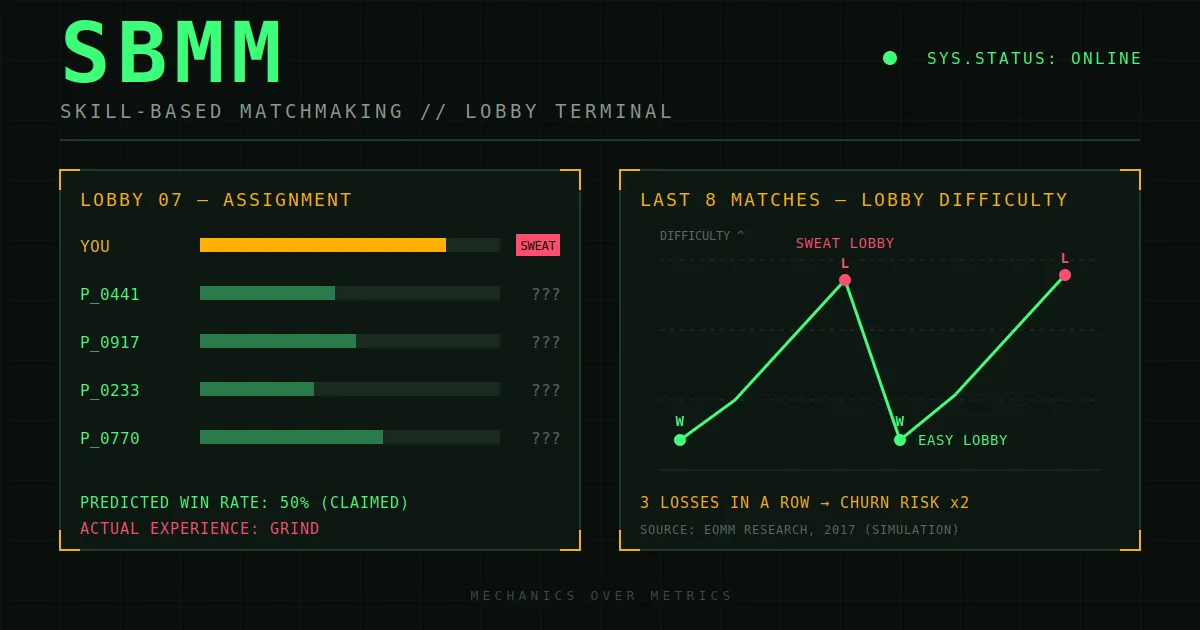
In 2017, researchers from Northeastern University, UCLA, and Electronic Arts published a framework called Engagement-Optimized Matchmaking (EOMM). Their finding, tested in simulation, was that strict fairness isn’t actually what keeps players online. Players who lost three games in a row were about twice as likely to quit as players with mixed results, and engagement-tuned matching retained 15% more players over twenty rounds than pure skill matching.
Here is the honest part, and it matters. No publisher has confirmed shipping EOMM in a live game. Activision publicly said its famous 2017 matchmaking patent was an exploratory R&D filing that was never implemented in any game. EOMM is published research, not a confirmed shipped system.
But you don’t need a confirmed EOMM deployment for the pattern to be real. Recency-weighted SBMM produces the same sawtooth on its own: win a few matches, your hidden rating climbs within three to five games, lobbies harden until your performance dips, and the cycle relieves. The oscillation feels scripted whether or not anyone scripted it, and memory bias does the rest, because you remember your worst lobbies and forget the easy ones.
And the research proves the incentive exists. If a system can tune difficulty for retention, the business case for doing it is already published in a paper with EA’s name on it. That is the part worth being suspicious about, and it is a suspicion you can hold without claiming a secret system you can’t prove.
The result: the game stops feeling like an organic competitive arena and starts feeling like an algorithm managing your win/loss cycle to maximize your screen time.
Can You Turn Off SBMM?
For almost all modern AAA titles, no. Developers keep SBMM and EOMM hardcoded into casual and unranked playlists.
Publishers maintain these algorithms because data shows they protect casual and low-skill players from getting stomped. Since low-skill players represent the largest percentage of any game’s player base—and purchase the majority of battle passes and cosmetics—protecting their retention takes priority over the experience of dedicated, high-skill players.
Frequently Asked Questions
Can you turn off SBMM?
In almost all modern AAA titles, no. It is hardcoded into casual and unranked playlists. Some games offer ranked modes with visible ratings alongside it, but there is no toggle for the hidden casual rating.
Is SBMM only in casual playlists?
No. Ranked modes use visible ratings by design. The controversy is specifically that hidden skill ratings also govern unranked and casual playlists, where players expected connection-based, relaxed matches.
What is the difference between SBMM and EOMM?
SBMM optimizes for fairness: it tries to give both teams a roughly equal chance. EOMM optimizes for retention: it tunes match difficulty to keep you playing, even if that means deliberately uneven matches. EOMM is a published 2017 research framework, not a system any publisher has confirmed shipping.
Why do my lobbies feel scripted?
Because recency-weighted SBMM creates a feedback sawtooth. Strong games raise your hidden rating within a few matches, lobbies harden until you cool off, and the cycle relieves. The oscillation mimics scripting perfectly while being ordinary control-loop behavior, amplified by the fact that you remember your worst lobbies and forget the easy ones.
The Takeaway
SBMM was designed with good intentions: to prevent new players from being obliterated the second they load into a server. But when tuned aggressively to drive daily engagement metrics, it strips away the variety, community, and relaxed fun that made online multiplayer great in the first place.
If your lobbies feel impossible tonight, don’t blame your aim—blame the algorithm pulling the strings behind the screen.